Operation Vaccination Binagunda

Maruthi, the young son of Binagunda’s patil (village head) has been working as kotwal with Bhamragad administration for the past few years. A few days back he trekked over 20 kilometers to inform Bhamragad Tehsildar that health team couldn’t find any success in vaccinating Madia tribals of Binagunda and other nearby villages. All villagers had refused to take vaccination from a health team that traveled to these areas recently. The fear of Covid rampaging his village in the next wave was clear in his hushed but concerned tone. The monsoon would also play spoilsport, as these villages would be cut off from the rest of the civilization for four months or so. The administration would lose any opportunity to vaccinate them at that time. The kotwal himself had been vaccinated, but he had not been able to convince many of his village folks. “Sir, please visit the villages, we need to convince our people to take the vaccination…”

On the evening of Buddhapurnima, May 26, the tehsildar called me about the problem at hand. We decided to chart a plan to vaccinate every eligible person of Binagunda and other villages nearby. After much deliberation, we decided to organize four vaccination camps on the line of election booths: one in Kuwakodi (the eastern most Gram Panchayat of Maharashtra), Permilbhatti, Fodewada and Binagunda each. All located in the infamous Abhujmarh, often referred to as the ‘liberated-zone’ by Naxalites, these villages are home to the Madia tribe that is recognized as Particularly vulnerable tribal Groups by the Government of India. Due to primitive nature of their lifestyle (by no means inferior), these tribes continue to live in seclusion from the rest of the world. Our fear lay in the cold hard fact that if the recent strains of Covid 19 make its way to these villages, lack of health facilities and immediate care could potentially lead to much misery and loss of human life. One way to address this problem would be to vaccinate as many persons of this area as possible, on a war footing level.
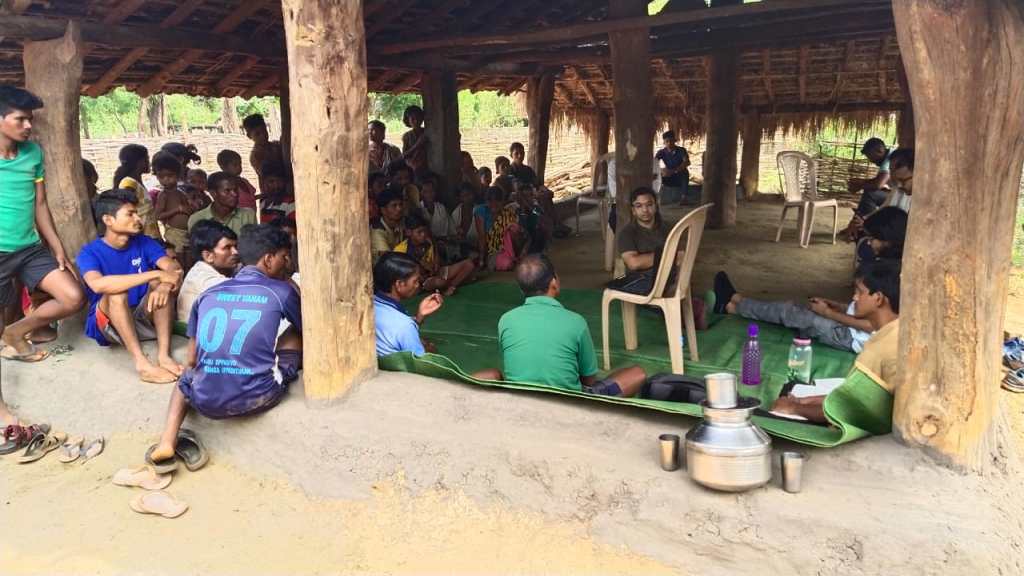
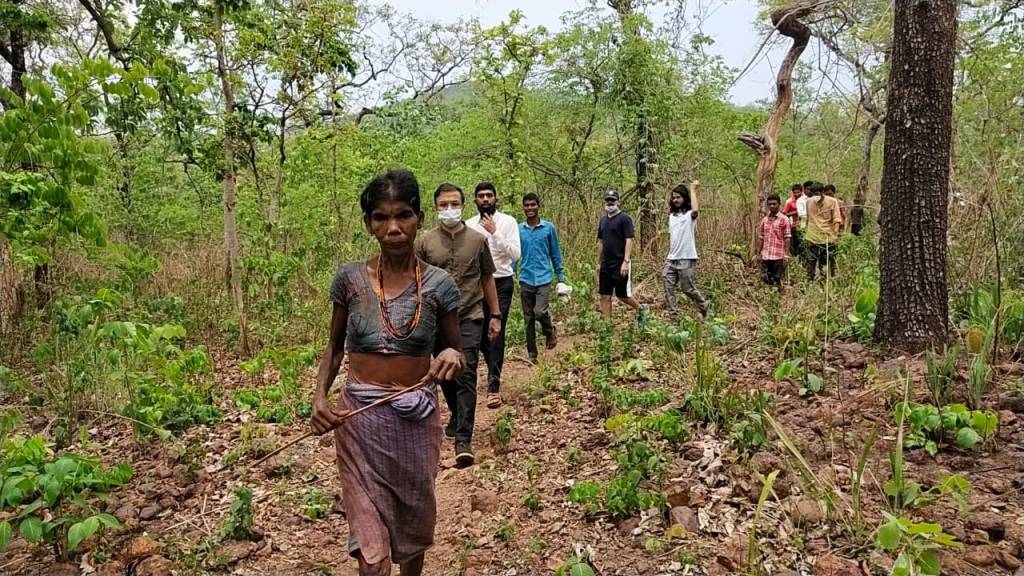
The vaccination camps were held on the lines of election exercise. It would have three components. First, an intense awareness campaign would take place in each village on Friday, May 28th. The administration team along with all the Patwari, Kotwals, and persons with influence in the area would travel to each village and organize meetings in the Ghotuls, the traditional meeting halls of the Madias. The traveling itself was dicey as our vehicle crossed at least five flowing rivulets, removed heavy stones along the forest trail and was stuck multiple times on a hilly and inaccessible terrain. All the villagers were informed in advance about the meeting and times were communicated by kotwals on foot the previous day. The first meeting was held at Fodewada, a hamlet of around 30 houses. The ‘ice-breaking’ session, as Tehsildar Anmol Kamble liked to refer it to, was done by talking about general issues faced by the villagers. It was key to establishing some rapport with the villagers. This was followed by transitioning to the topic of health and Covid. A video of local leaders and influencers like Prakash Amte ji, who has a very recognizable face in Bhamragad was shown to all. It instantly struck a chord with many of them as all the influencers spoke in their language, explaining Covid and how vaccination could protect them. Afterwards, we took the questions of each villager with much patience. In the classic dialectic method, which is still practiced in this area, both sides presented arguments. One of the village seniors wanted us to visit the nearby water source first and address the water problem as well. She led the way as we trekked almost a kilometer in deep jungle to learn that she had been ferrying water on foot for all her life. It was her chance to have us feel the problems she lived everyday. The meetings went much beyond the Covid as they enabled us to note many problems faced by these inaccessible areas. By the end of the day, the team noticed that it had taveresed over 10 kilometers on foot while walking through these villages. Eventually, home visits and Ghotul meetings ensured that all the villages were convinced to get vaccination by the end of the long but fruitful day.
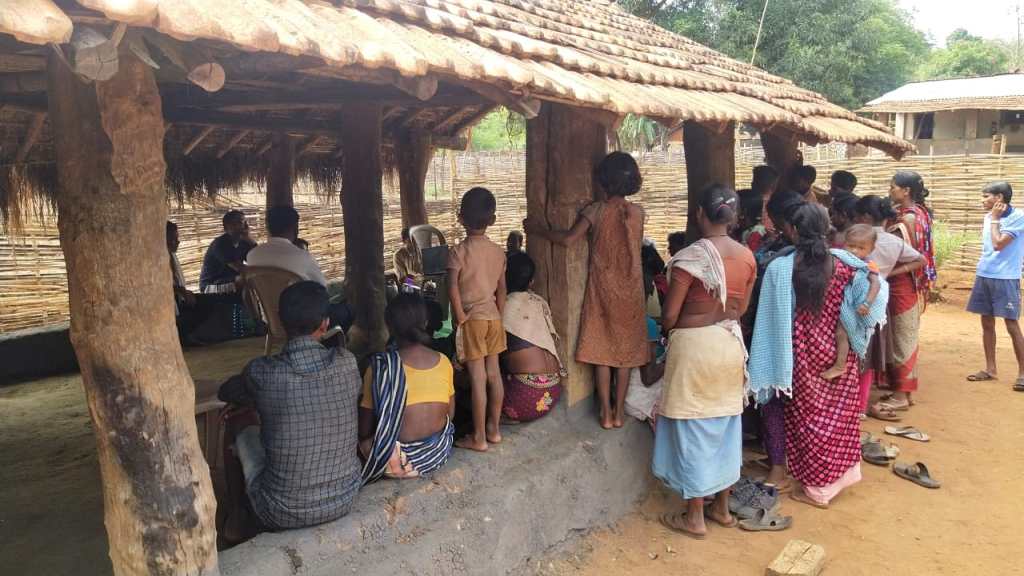
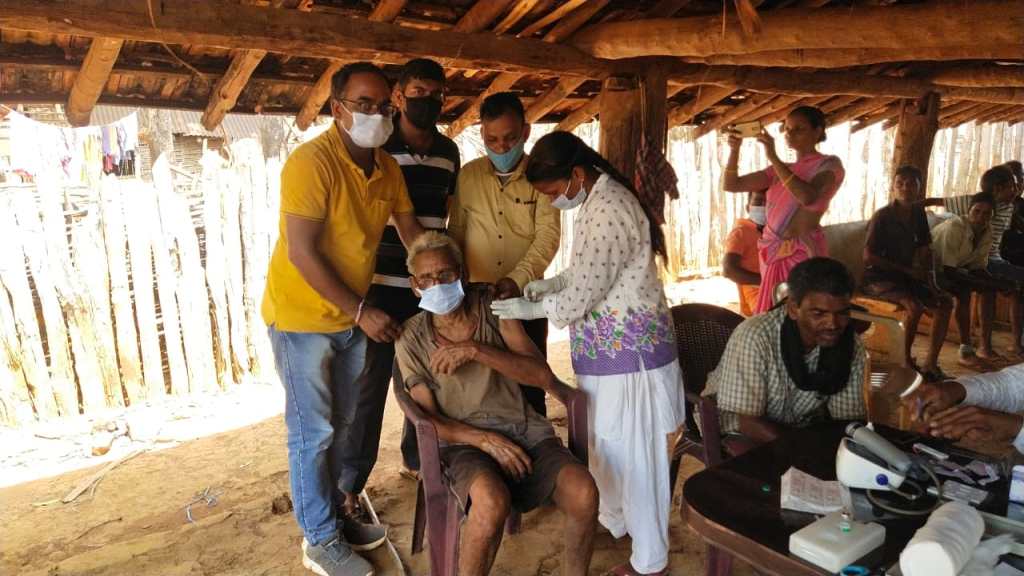
The next morning, ‘vaccination booths’ was set up in each village. Two health teams traveled with vaccine in the pulse polio cold boxes, now used for storing and transporting Covid vaccine in the nearby areas. The vaccination booth agent was armed with the list of all villagers above 45 years of age. These were extracted from the electoral rolls already available with the administration. The first to get vaccinated was the local Patil, Maruthi’s father. He led by setting an example for all to follow. One by one, as the villagers trickled in the booth, their aadhar card numbers were written down and vaccine shots were administered after testing their blood sugar levels, blood pressure and other vitals. Many were encouraged to come out of their houses and get vaccinated. A little hesitation and concern was still visible on some old, sun-spotted faces, but much of the vaccination team couldn’t hide a huge sign of relief on theirs. 59 out of 68 persons, almost 87% of the entire eligible population were vaccinated. Almost everyone beyond 18 years of age is eagerly awaiting for their chance as well. As the day ended, we knew that with the right awareness campaign, some personal touch from vaccination warriors, and a clear system and process of vaccination, we could defeat vaccine hesitancy and vaccinate one village at a time in the entire area.

I would like to give all the credit of this Operation Vaccinate Binagunda to Tehsildar Anmol Kambde and the team, Sattu, Kotwal-Phodewada, Dinkar Kotwal-Turremarka, Chukku Kotwal-Kuvakodi, Maruti Kotwal-Binagunda, Shankar Kotwal-Laheri, and Akash Kotwal-Malampodur.
“It’s Okay to Miss”

Nelgunda has remained a bastion of Naxal activity for years now. Its proximity to Chattisgarh, lack of any government presence in the area, complete absence of schools and medical facilities, and location in the deep jungles make it suitable for guerilla warfare and for activities of ‘jungle ke log’. That is how the locals refer to the Naxal militia here. 

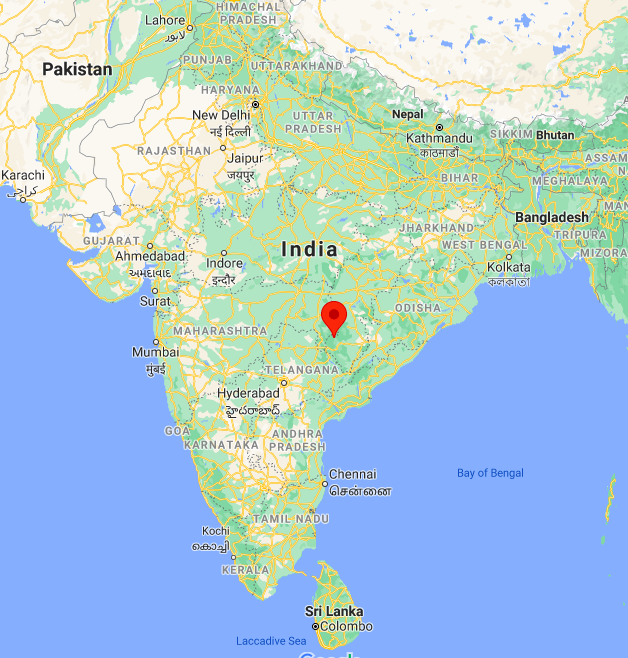
Nelgunda lies on the border of Chattisgarh and Maharashtra in the ‘Abhujmarh’ area..

I met the Amtes of Lokbiradri Prakalp and had long discussions about a variety of topics, including the education system in these interior areas. Lokbiradri Prakalp established by Shri Prakash Amte runs a large hospital and schools in Bhamragad. Shri Amte’s words are that of gold in these rough, government-less areas. Years of selfless public service for the tribals has earned the project so much goodwill that not even the staunchest of the Naxals target them. 

Aniket Amte and his wife Samiksha suggested why not I visit a school they had been running in Nelgunda for a few years now.  A parents-teachers meeting day was to be held soon. They invited me to join them for a day full of fun activities at the village. I thought this was a perfect opportunity. They directed me to meet at Lokbiradari Project sharp at 6 am to start our 2 hour long drive. We hopped into a Tata Safari, with Lokbiradri Prakalp painted over it. This certainly assured me that traveling with them would be safe and also ensure that I can listen to the grievances of the people first hand while with them. Afterall, people from these villages talked to the Amtes freely and openly. 

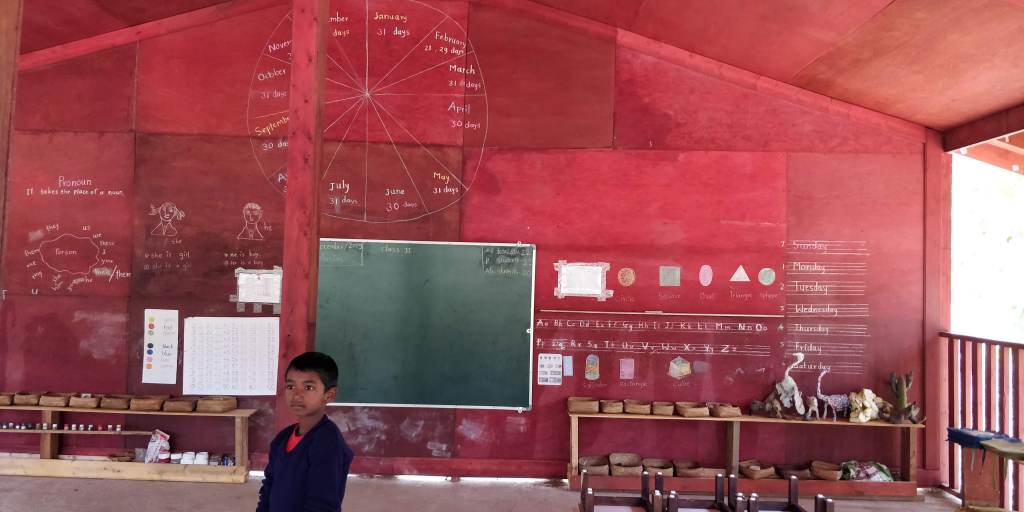
The beautiful classroom of Sadhna school at Nelgunda, a strong-hold of CPI-Maoist party

My ride to Nelgunda was more than just memorable. At first it was comfortable and the scenic beauty of the forests surrounding us with patches of bright, green rice fields was mesmerizing. A  camera can never do justice to such a beauty. Forty five minutes into the drive we turned rightwards at Dodhraj village and made our way onto the kaccha paths towards Nelgunda. The next two or so hour kaccha road was certainly more beautiful but also treacherous. It didn’t help that I had forgotten to eat in the morning. The Amtes had offered breakfast at their home, but I felt I couldn’t impose and declined, much to my own dismay later! 

The SUV easily made its way through the intense jungles and the streams that flowed across every few kilometers. At some stretches, it seemed that kaccha road was recently cleared of mud and stones and paved after some intense labour work. Curiously I inquired Aniket about this. He told me that the villagers had repaired the road last night just so that our vehicles could pass freely. This surprised me! It only spoke volumes about the respect and importance villagers attach to the work done by the Amtes in these areas. 

At one spot, we noticed a burned down vehicle and police drawn lines of a corpse on the ground. We stopped for a moment, then Aniket decided to swirl his vehicle from the side and drive across. He informed me that a person was shot dead last night by the Naxals right on that spot and the vehicle was burned down. He also pointed to a tree across the river where a prominent tribal leader from the Congress party was hanged to death after he refused not to withdraw from running for elections on command of the Naxals. After he died of the hanging, he was shot multiple times to send a stern message across the entire area. Noone could defy the writ of the jungle ke log. I couldn’t believe he decided to break this rather important piece of information with me after bringing me 50 kilometers deep into the red territory! Alas, I had no choice but to continue my ride.

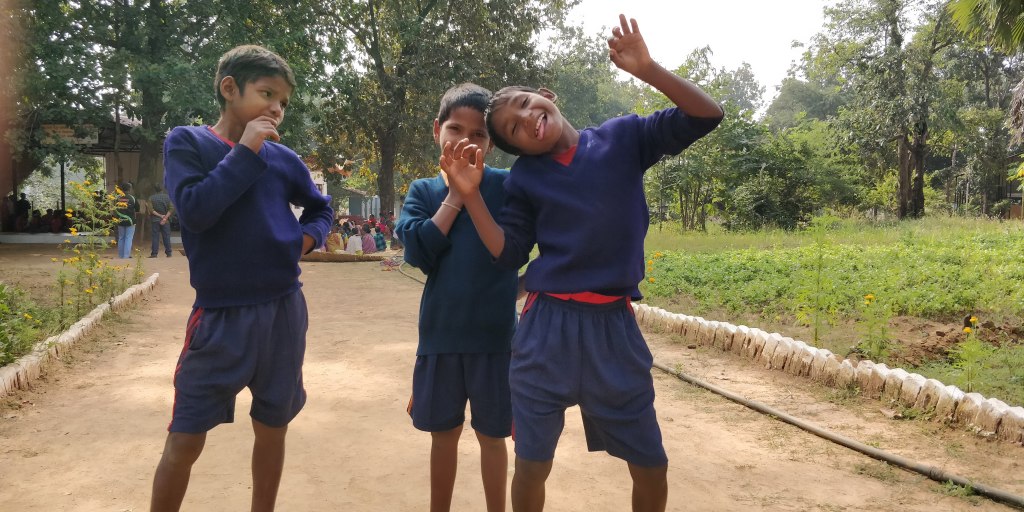
The three musketeers of Sadhna..All three spoke fluent English and accompanied me everywhere in the school

We reached the village of Nelgunda at around 8:30 am. It was a small and humble settlement spotted mostly with mud huts. Every hut in this tribal area is made of local materials. The walls are erected with yellow soil and rice husk. The roof is supported by timber from the forest which is used for building strong trusses and gussets. The outer roof, which is the most striking feature of a Madia hut, is made with deep-brown baked clay tiles. Few Gorga trees stand tall near almost every hut. Gorga is used to make a local beer which is in great demand during the winters. Every household brews its own. Those who don’t get their supplies from the neighbours can always climb a tree, bring down some beverage and concoct their own mix on the go.   

After passing through the village, we entered the Sadhna school. We were welcomed by lovely students and I was assigned to three young students who would show me around the school. Chinnu, Chukku and Mangu were their names. To my surprise, all three spoke in fluent English. And I am talking about well thought out responses in English, not the ones that are pre-fed to them. They accompanied me for the entire day and told me many stories about their struggles and daily chores. To them, it was a normal course of life as it happens. Chakku travelled 6 kms every day, one way, to reach the village after crossing a thick jungle to get his education at Sadhna. Chinnu wanted to become a doctor. Mangu was rather shy, but I could see the storm brewing in his deep eyes. These tales of daily struggles made me feel very lucky and privileged.

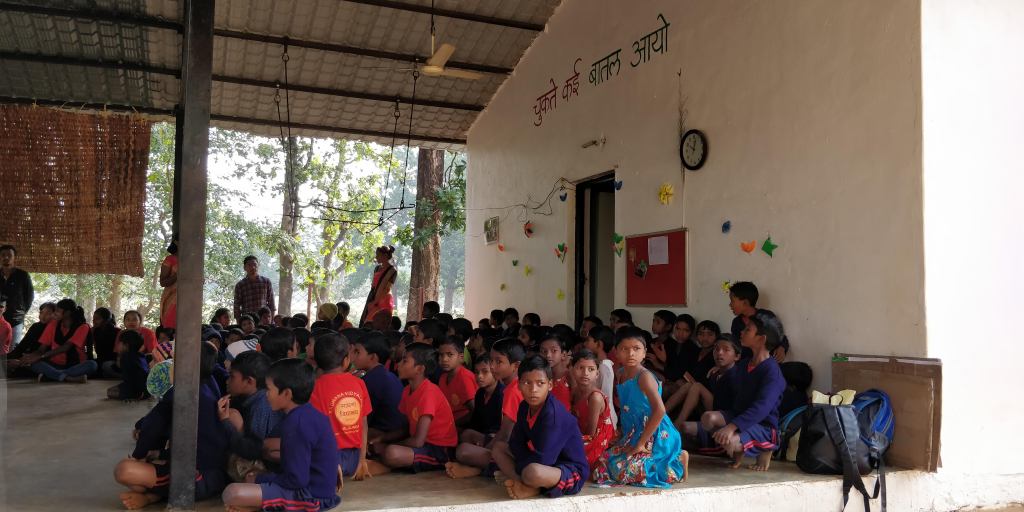
The cultural program started after sometime. The kids danced and presented street plays against tobacco chewing, which is a big health concern in these areas. I couldn’t help but notice the words on the main hall wall, “Chukte Kai, Batal Ayo”. These Madia words translated in Hindi mean “Chuk gaye…koi baat nahi!”, or “It’s okay to make mistakes..”.  The significance of these words cannot be understated. In the tribal areas, students witness a many learning obstacles, one significant being that no one ever has received any formal education of any kind in their communities. Most are first generation learners. They have to cope up with concepts from traditional syllabus devised keeping urban students in mind. For instance, “A for Apple” has no meaning to a tribal students in these areas. They have never seen an apple in their lives! This makes the learning process far more complex and challenging. Therefore, missing on concepts shouldn’t be punished but encouraged and addressed in any education curriculum here. 

Sadhna founders have tried to address this by developing their entire curriculum in Madia language. It derives many lessons from the way Madias live — as hunter gatherers, spending their days in the outdoors. It uses activity based learning techniques combining games and lessons from nature and their daily activities to teach them basic math, language, science and other such subjects. They also trained local boys and girls to become teachers and employ them here. This is critical because deep areas like Nelgunda have always been treated as ‘punishment postings’ for government teachers and staff. By hiring local boys and girls and training them, there is more accountability and performance is better.

“Chukte Kai, Batal Aaya” in Madia means It’s okay to miss. The idea of perfection in education is highly flawed. We must accept that every child learns differently.

Post a sumptuous lunch of daal and chawal served langar style on a leaf plate, the village elders sat down for some serious business with me. They informed me about the recent firing by the police in which two villagers were killed. While the police contended that these two were Naxal militia, the villagers gave a written representation that the two were simple villagers who were forced by the naxals to bring food for them in the forest they were camping in. It was no fault of the villagers and neither did they have a choice. 

Incidents like these have presented an ethical dilemma that confounds me to this day. The State’s police machinery has to do its job in defending it from the Naxal threat. However, once  every while, simpleton villagers with no association with the naxals or the State get entangled. They are sandwiched between the two behemoths and only end up paying the price with their blood. Then who is to blame? The State for its long apathy to the conditions of the tribals, against which the whole Naxal movement revolted and finally woke up the giant State from its slumber? Or the Naxals for using the innocent tribals as their resource base? The question continues to linger on my mind as my journey in Bhamragad evolves every moment.